Overview
This project develops a physics-based simulation of a jack bouncing inside a rotating cup using first-principles rigid body dynamics. The system is modeled using the Euler–Lagrange formulation, incorporating inertia modeling, constraint-based impact detection, and external forcing.
The goal was to create a realistic dynamic simulation capturing rotational coupling, collision effects, and energy transfer between bodies.
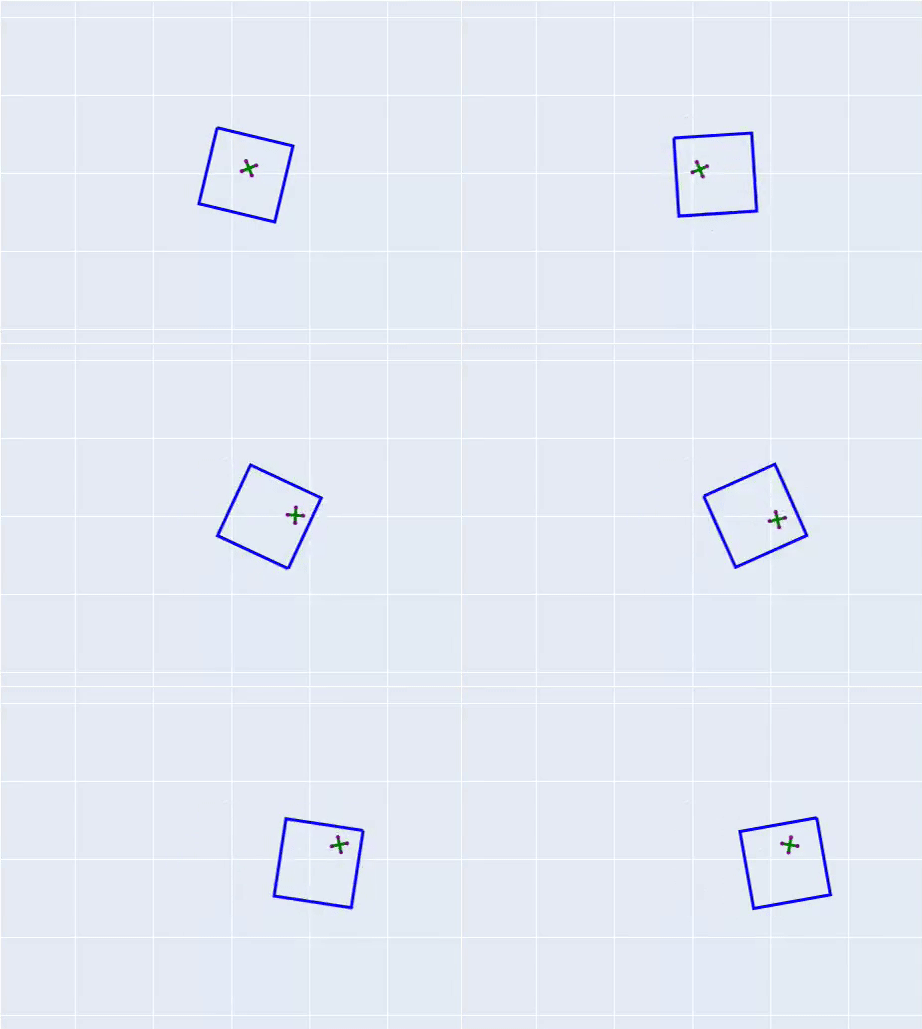
Demo
System Modeling
Inertia Modeling
- Cup
- Approximated as four rectangular prisms
- Inertia of each wall computed and combined using the parallel axis theorem
- Jack
- Modeled as four point masses at equal distance from the center
- Total inertia computed using the parallel axis theorem
Mass matrices were constructed for both bodies and used to compute body twists from their respective transformation matrices.
Lagrangian Formulation
Generalized coordinates:
[ q = (x_1, y_1, x_2, y_2, \theta_1, \theta_2) ]
Steps:
- Compute kinetic energy using body velocity formulation
- Compute gravitational potential energy from rotation matrices
- Form the Lagrangian
[ L = T - V ]
- Apply Euler–Lagrange equations to derive system dynamics
This produced a coupled nonlinear dynamic model of the jack–cup interaction. :contentReference[oaicite:0]{index=0}
Collision Detection and Constraints
Impacts were modeled using geometric constraints:
- Each cup wall ( e_1 - e_4 )
- Each jack mass ( r_1 - r_4 )
- 16 relative position constraints
At each timestep:
- If displacement fell within a tolerance → collision detected
- Post-impact velocities computed using elastic collision equations
This enabled realistic bouncing behavior inside the cup. :contentReference[oaicite:1]{index=1}
External Forces and Excitation
To generate sustained motion:
- Upward force applied to counteract gravity on the cup
- Sinusoidal forcing applied to simulate shaking
- Additional gravity compensation added for the jack
- Small initial velocity introduced to initiate impacts
These inputs produced continuous interaction without the system drifting out of frame. :contentReference[oaicite:2]{index=2}
Results
The simulation successfully demonstrated:
- Coupled motion between jack and cup
- Momentum exchange during impacts
- Variable rotational behavior depending on collision geometry
- Energy transfer causing acceleration, damping, or spin reversal
The motion qualitatively resembled a physical jack bouncing inside a shaken container. :contentReference[oaicite:3]{index=3}
Key Takeaways
- Implemented full Euler–Lagrange dynamic modeling for a multi-body system
- Developed collision detection with constraint-based logic
- Modeled realistic rigid-body interactions and energy transfer
- Explored stability challenges in simulation and force design
Possible Improvements
- More realistic gravity treatment (currently simplified for visualization)
- Friction and damping modeling
- Contact dynamics instead of elastic impact assumption
- Removal of artificial initial velocity